
Project Details
Community Education & Outreach Portal
The Community Education & Outreach (CEO) project is a request by the Louisiana Governor's Office of Homeland Security and Emergency Management (GOHSEP) to collect data and improve functional enhancements that facilitate Louisiana’s ability to quantify remediation impacts of hazard mitigation investments and develop assessment instruments to communicate risk. Conceived as two parts, the NIMSAT Institute will work with GOHSEP to develop the “Disaster Informatics” Repository and a “Disaster Analytics” Framework.
- Disaster Informatics Repository: The “Disaster Informatics” repository is envisioned as a foundation for the improved collection of data related to threats, vulnerabilities, and consequences. To accomplish these objectives, the NIMSAT Institute proposes to expand upon existing data collection and management features developed for the ongoing CEO project to improve upon existing data available through FEMA, GOHSEP, and other agencies.
- Disaster Analytics Framework: Built upon the foundation of such informatics, the Institute will develop the “Disaster Analytics” Framework for computation of risk using a systems-based risk management approach and its communication to the general public, in addition to providing tools and processes developed based on processes and guidelines established by the Department of Homeland Security and Federal Emergency Management Agency.
The benefit of this process for the CEO program is the development of a data repository of hazards across the state and the impacts of those hazards, including loss of life, property damage, cost of managing the disaster, and disruption to the economy. The database will also capture the state’s investments into mitigation through the Hazard Mitigation Assistance (HMA) Programs to identify a reduction in vulnerabilities, which can in turn be reflected in local and state Hazard Mitigation Plan (HMP) development. This will directly benefit the improved quantification of risk defined as the triad of (threat * vulnerability * consequence), wherein hazards translate into threat, mitigation investments (or lack thereof) translate into vulnerability, and impacts translate into consequences.
Big Business – Small Business Disaster Mentorship Program
The Big Business—Small Business Emergency Management Mentorship Program is designed to motivate and encourage large businesses to provide mutually beneficial emergency preparedness, response, and recovery expertise to small businesses. The program was created to improve small businesses' resiliency and reduce recovery time after a disaster.
In true respect to the proactive "whole community" approach to emergency management, the Big Business - Small Business Emergency Management Mentorship Program results in a "win-win" for everyone!
Incentives for Big Businesses
- Strengthen the resiliency of customers within your supply chain and local communities
- Create positive branding and reputation for your business
- Share "lessons learned" within your industry
- Create networking opportunities
Incentives for Small Businesses
- Learn from leaders with a proven track record
- Grow as a business
- Develop the tools to recover from disasters
- Build beneficial relationships with big business partners
Intelligent Flood Protection Monitoring, Warning & Response System
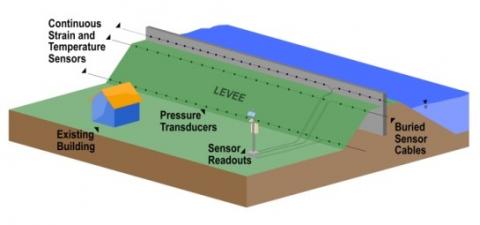
The State of Louisiana Office of Coastal Protection and Restoration (OCRP) deployed a state-of-the-art Intelligent Flood Protection Monitoring, Warning, and Response System (IFPRMWRS) at strategic locations within the flood control systems under its responsibility. This system will include the ability to monitor and warn of undesirable performance that could lead to catastrophic consequences. These warnings should occur early to facilitate defensive measures and evacuations. The system should always remain operational, robust, and reliable, including throughout a 500-year hurricane or 500-year flood. The current focus is on the New Orleans Metropolitan Area, but the approach must be scalable to all flood protection systems within OCRP’s responsibility. Further, it must be scalable to future additions and improvements in technology. The system must be sustainable for a minimum period of 50 years.
The IFPRMWRS are capable of monitoring the condition of the flood protection system both during and between storm and flood events. The intent is to provide real-time information to aid in evaluating the system's flood readiness and provide real-time input on the conditions leading up to the possible failure of system components during a flood event to provide warnings. Between flood events, the flood protection system would be monitored to provide indications of small movements or deformation, which could be inspected, evaluated, and repaired before a storm or flood event. A full-scale instrumentation program would follow this first phase based on the recommendations developed by this program.
Intelligent Levee Surveillance
Critical Infrastructure Research
- Energy and Petrochem
- Utilities (Water, Waste Water)
- Energy Assurance Planning
Enabling Research Areas
- Oil spill Management, Hazardous Waste Treatment, Debris Management, etc.
- Sensors & Sensor Networks
- Smart Grids, Telecommunication & Wireless Networking
- Transportation Safety
- Autonomous Robotics
LA 1 Port Fourchon Study
A study was conducted to provide an assessment of the national consequences of disruptions to LA-1. The study evaluates the reduced ability of the nation to deliver two critical commodities (crude oil and natural gas) to the American public as a result of the loss of LA-1. The study also addresses local, regional, and national economic impacts due to a disruption of LA-1 for an extended period of time.
This study has been prepared, in collaboration, by the National Infrastructure Simulation and Analysis Center (NISAC) and the National Incident Management Systems and Advanced Technology (NIMSAT) Institute located at the University of Louisiana at Lafayette. NIMSAT’s effort was funded by the LA-1 Coalition, a group that is a proponent of enhancing LA-1 to make it less likely to be disrupted.
View Report
For more information, contact the NIMSAT Institute.